
America… GODDAMN

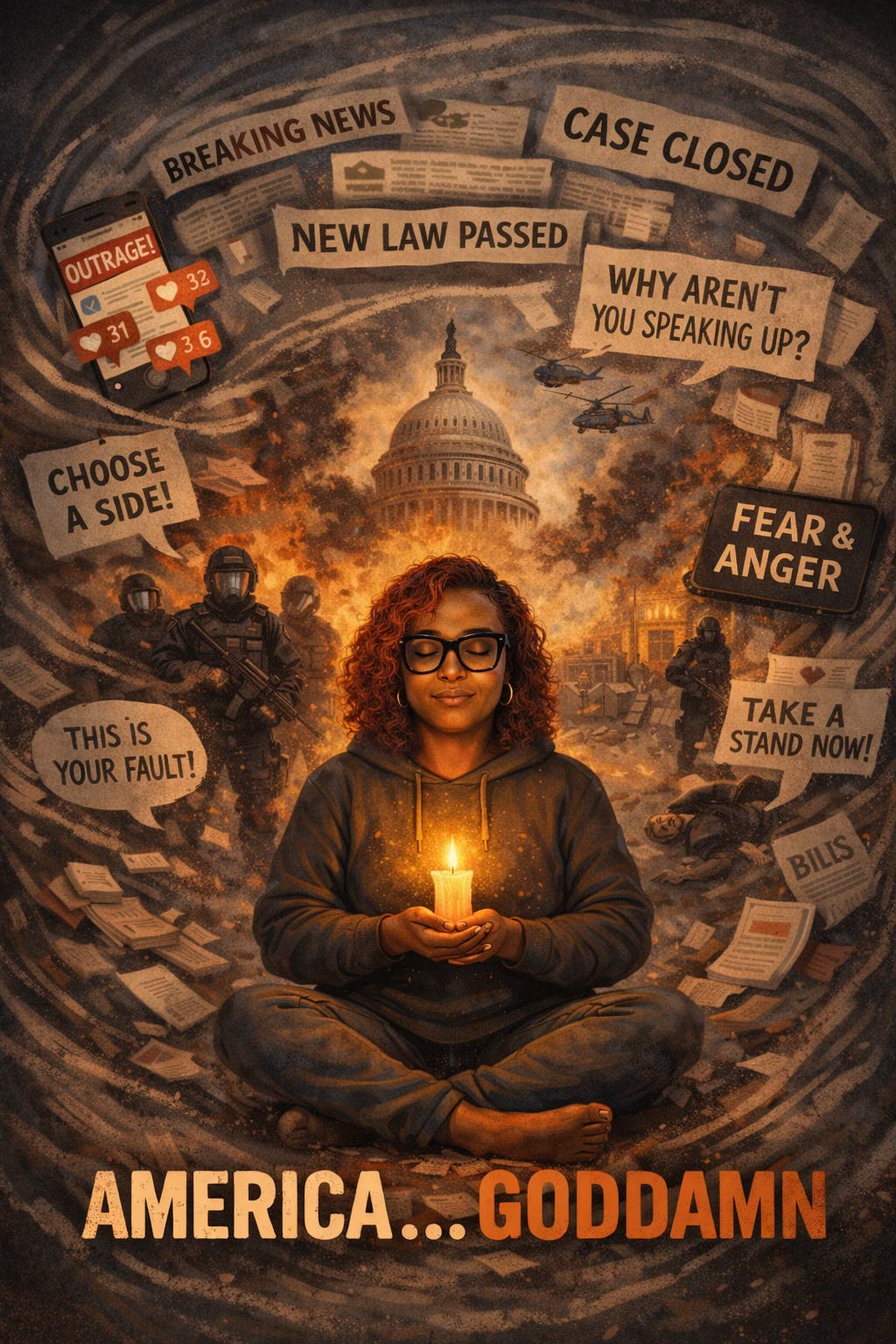
If you came here for a “both sides” breakdown or a timeline you can use to argue online, you’re in the wrong place.
I move slower than the algorithm on purpose.
Because liberation requires clarity, not adrenaline.
I also move slower because I am grieving.
I grieve for a family whose world has been irrevocably altered.
I grieve for a child who will grow up with an absence no explanation can fill.
I grieve for the way death is turned into content before breath has even settled.
Grief creates space.
It keeps me human while I gather my thoughts.
Before we talk about law, narratives, or outrage… pause.
Unclench your jaw.
Notice your breath.
If your body is already bracing for a fight, that’s not a personal failure. That’s conditioning.
I’m not a reporter.
I’m not here to deliver hot takes or feed the churn.
I’m here to respond, not react —slow, embodied, intentional— so I can process what we’re witnessing without becoming numb, reactive, or conscripted into someone else’s agenda.
I help us slow down when urgency is being used as a weapon. I help us notice what our bodies are doing while the internet demands we decide, condemn, defend, or celebrate…
immediately.
So if you’re looking for a clean conclusion, this may not be the piece you want.
But if you’re willing to stay with complexity a little longer
with grief, dissonance, and unanswered questions —
keep reading.
We’re going to look at this from multiple angles.
We’re going to name what the law claims to be and how power actually behaves.
And we’re going to do it without rushing past our own humanity.
We’re also going to talk about how we stay.
How we remain present without becoming hardened.
How we metabolize grief without turning it into spectacle.
How we resist supremacy culture without reproducing it.
How we build community that is not organized around trauma bonds, outrage cycles, or shared enemies — but around shared humanity, accountability, and care.
That is the scope of this work.
What happened to Renee Nicole Good is already being flattened into familiar scripts—lawful or unlawful, justified or tragic, closed or open.
But flattening is how we avoid reckoning.
So before we parse statutes or footage or headlines, we need to talk about speed, and why it is always the first thing demanded when state violence enters the public sphere.
But, before I Continue
I need to name something plainly.
This is my work.
This is not a hobby.
This is not content I dash off for engagement.
This is not a hot take squeezed between other obligations.
This is my job.
I spend my time doing this work — thinking, researching, holding grief, tracing patterns, building frameworks, and helping people stay steady in moments designed to destabilize us. I do this because it matters, and because many of us are desperate for spaces that do not demand urgency, certainty, or performance.
If this work has helped you slow down…
If it has helped you think more clearly…
If it has helped you stay human when the world is asking you to harden…
I need your support.
My goal is 1,000 paid subscribers so I can continue doing this work sustainably.
If you’re already subscribed, I’m asking you to invite five people you know, friends, colleagues, family who need this kind of orientation and care.
This is how independent, liberation-centered work survives.
Everything below this line is part of that labor.
Thank you for being here.
A Culture Addicted to Speed
One of the most revealing things about the killing of Renee Nicole Good is not the footage itself.
It’s the pace.
Within hours, the public had already been sorted into camps. Comment sections hardened. Legal language was deployed by all. Phrases like “case closed,” “self-defense,” and “she got what she deserved” appeared almost instantly… before investigations, before full context, before breath.
I felt it too.
That familiar pressure to have something to say.
To post.
To respond.
To prove relevance in the middle of someone else’s death.
And I had to stop and ask myself: why?
Do we really need more people talking?
More speculation?
More certainty performed before grief has even arrived?
Or do we need more steadiness?
More grounding?
More deepening?
Because before the now-orphaned child was even picked up by their grandparents,
the footage had already circulated,
the narratives had already calcified,
and the conclusions had already been drawn.
Decisions were made.
Judgments issued.
Moral certainty declared.
All while a child’s life was still rearranging itself around an irreversible absence.
This speed is not neutral.
Speed pays.
Speed generates views, clicks, shares, and outrage cycles. It rewards certainty over accuracy and reaction over reflection. It turns death into content and grief into discourse before anyone has had time to feel what actually happened.
Everyone rushes.
Everyone spins.
Everyone performs knowing.
And in the middle of that, I choose steadiness.
Not because I’m detached.
But because those of us called have to be an anchor.
Those of us called must be a lighthouse.
Urgency is one of the central pillars of supremacy culture. It narrows the field of vision. It suppresses grief. It replaces discernment with decisiveness. And it trains us to believe that if we are not reacting immediately, we are failing.
Historically, when empires feel stable, they can afford deliberation.
When they are flailing (when legitimacy is thin and trust is brittle) they rely on speed.
Decide now.
Align now.
Close the case now.
Liberation does not move this way.
And neither do I.
Beyond this point is the space for those who sustain my ability to go slow, grieve, and provide you the tools to do the same. $10 a month $100 a year $150 as and equity partner and no questions asked, scholarships always available at: Scholarships@desireebstephens.com
