
Juneteenth, Redistribution, and the Difference Between Celebration and Solidarity

Juneteenth is approaching.
Every year, more people learn about it.
Every year, more corporations acknowledge it.
Every year, more businesses market around it.
And every year, I find myself asking the same question:
Who is benefiting from Juneteenth?
Not who is celebrating.
Who is profiting?
Because while I absolutely believe liberation is collective work, I also understand that we cannot talk honestly about Juneteenth without talking about economics.
For centuries, wealth in this country was built through the extraction of Black labor, Black bodies, Black land, Black knowledge, and Black culture.
That wealth did not disappear.
It accumulated.
It compounded.
It was inherited.

And the effects of that extraction continue to shape who has access to opportunity, housing, education, healthcare, generational wealth, and economic security today.
Sometimes I think we rush too quickly to celebration because sitting with the truth is uncomfortable.
Juneteenth is a celebration.
It should be.
Black people have every right to celebrate survival.
To celebrate joy.
To celebrate culture.
To celebrate the ancestors who endured what should never have been endured.
But Juneteenth is also complicated.
Because freedom arrived late.
More than two years late for those enslaved in Texas.
And even then, freedom did not arrive with land.
It did not arrive with reparations.
It did not arrive with generational wealth.
It did not arrive with safety.
It did not arrive with equality.
The chains were removed, but many of the systems remained.
And in many ways, they still do.
That is what makes Juneteenth both beautiful and heartbreaking.
We celebrate because our ancestors survived.
We grieve because they should never have had to.
We dance because joy is resistance.
We remember because forgetting is dangerous.
We gather because community has always been one of the ways Black people transformed suffering into possibility.
There is something sacred about the way Black communities have always found a way to make room for joy.
Not because life was easy.
Not because justice had arrived.
But because joy itself became a declaration.
A refusal.
A reminder that our humanity could not be stolen.
Juneteenth carries that energy.
It is the sound of laughter around folding tables.
The smell of food prepared from recipes passed down through generations.
The music.
The stories.
The elders.
The children running through spaces their ancestors could only dream of occupying freely.
It is grief and gratitude sitting side by side.
It is remembering who survived long enough for us to be here.
And it is asking ourselves what we are going to do with the inheritance of their survival.
Because our ancestors did not endure so that we could simply remember them.
They endured so that we could continue the work.
For many Black families, Juneteenth is not history.
It is memory.
It lives in family stories.
In economic realities.
In neighborhoods.
In schools.
In healthcare outcomes.
In whose labor is valued and whose is exploited.
In whose mistakes become lessons and whose mistakes become life sentences.
The past is not past.
It is present.
And if we are going to honor Juneteenth honestly, we have to be willing to hold both truths at once:
The joy of liberation.
And the unfinished work of freedom.
Somatic Break: Notice What Arises
Before you continue reading, pause.
Take a slow breath.
Then another.
Relax your shoulders.
Unclench your jaw.
Place one hand on your chest and one hand on your belly.
Now ask yourself:
What am I feeling right now?
What emotions arise when I hear the word redistribution?
Where do I feel those emotions in my body?
What stories am I telling myself about money, fairness, responsibility, or scarcity?
Notice without judgment.
You do not need to fix anything.
You do not need to defend anything.
You do not need to prove anything.
Simply notice.
Discomfort is information.
It is not an emergency.
Take three breaths.
Then continue.
Holding Both Truths
I want to be clear about something.
This article is not an argument against celebrating Juneteenth.
Celebrate.
Gather.
Dance.
Cook.
Laugh.
Rest.
Support Black businesses.
Attend the festivals.
Wear the shirts.
Listen to the music.
Tell the stories.
Joy matters.
In fact, Black joy has always been an act of resistance.
What I am challenging is the belief that celebration is enough.
One of the pillars of supremacy culture is Either/Or Thinking.
Either we celebrate or we critique.
Either we are grateful or we demand more.
Either we focus on joy or we focus on justice.
Either we honor progress or we acknowledge harm.
But liberation invites us into Both/And.
We can celebrate Juneteenth and talk about the racial wealth gap.
We can honor the resilience of our ancestors and acknowledge the harm they endured.
We can gather in community and examine the systems that continue to create inequity.
We can experience joy while remaining committed to justice.
We can celebrate freedom while recognizing that freedom remains incomplete for many.
This is what it means to release Either/Or Thinking.
We do not have to choose between celebration and accountability.
We do not have to choose between gratitude and responsibility.
We do not have to choose between joy and liberation.
The truth is that Black communities have always held both.
We have always known how to laugh while grieving.
To dance while struggling.
To build while healing.
To celebrate while organizing.
To find joy without denying reality.
That is not contradiction.
That is resilience.
That is wisdom.
That is liberation.
And perhaps one of the most powerful ways to honor Juneteenth is not to avoid the tension, but to learn how to hold it.
Because freedom is not found in reducing complexity.
Freedom is found in expanding our capacity to hold truth.
So when Juneteenth arrives
And businesses, organizations, creators, and communities generate additional revenue because of Black history, Black culture, Black resilience, and Black liberation struggles, I think we should be asking a deeper question:
What happens to that money?
Because if Juneteenth simply becomes another opportunity for colonial capitalism to monetize Black suffering, resistance, and survival, then we have missed the point entirely.
This is not about guilt.
This is not about punishment.
This is about responsibility.
It is about stewardship.
It is about understanding that solidarity is not measured by attendance.
It is measured by action.
When I talk about redistribution, I am not talking about charity handed down from a place of superiority.
I am talking about relationship.
I am talking about reciprocity.
I am talking about understanding that none of us arrive where we are alone.
Every one of us is standing on the labor, sacrifice, wisdom, and care of people who came before us.
The question is not whether we have benefited from community.
The question is whether we are willing to invest back into the communities that continue to make our lives possible.
Because redistribution is not just about money.
It is about returning resources to the places where extraction has occurred.
It is about choosing repair where harm has been normalized.
It is about understanding that liberation is not an individual achievement.
It is a collective responsibility.
So for my white friends, white-led organizations, and businesses earning income through Juneteenth events, sponsorships, promotions, speaking engagements, merchandise, consulting, festivals, and programming:
How are you redistributing those earnings?
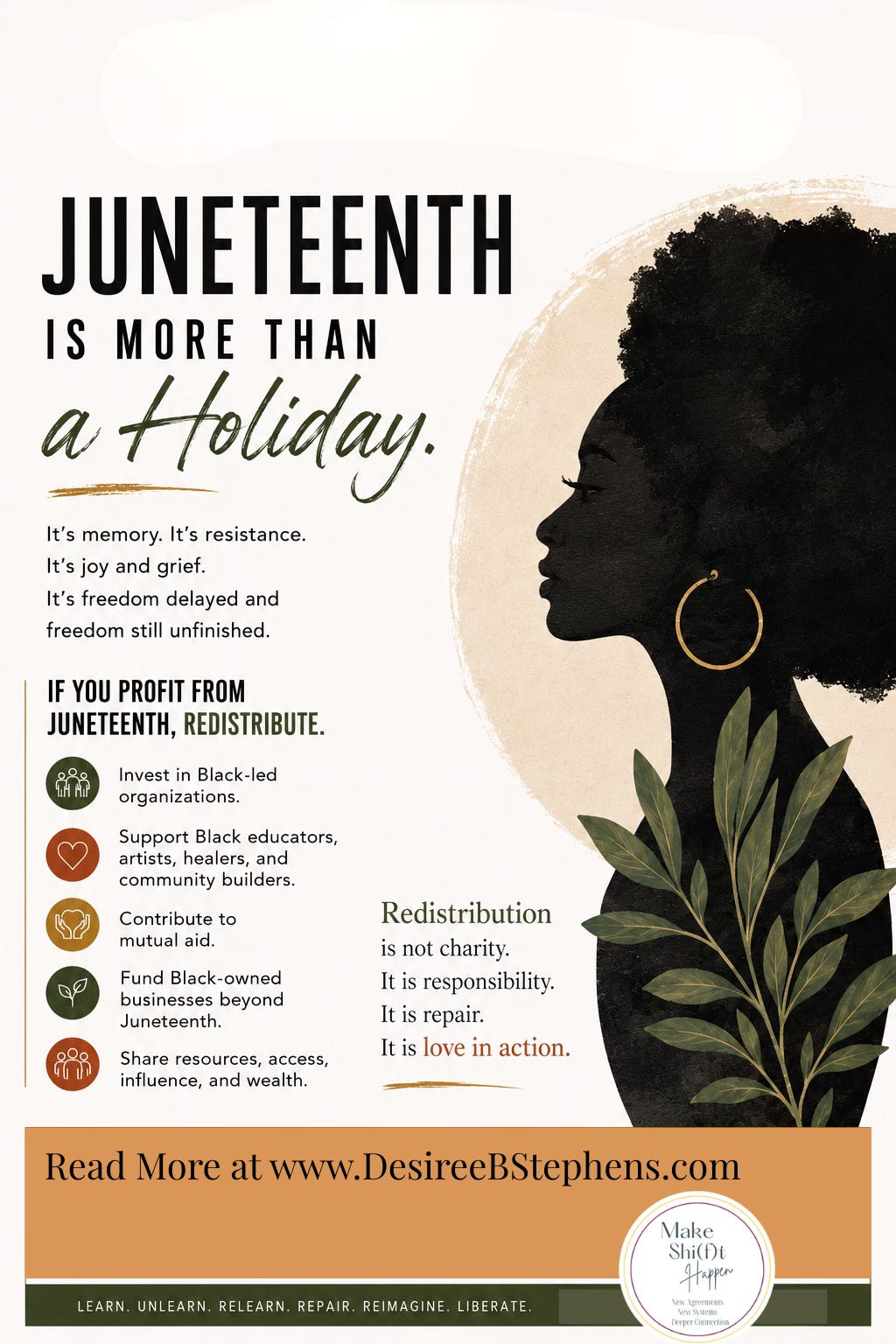
Are you investing in Black-led organizations?
Are you supporting Black educators, artists, healers, and community builders?
Are you contributing to mutual aid efforts?
Are you funding Black-owned businesses beyond Juneteenth?
Are you helping create opportunities that outlast a single day of celebration?
Are you sharing resources, access, influence, and wealth?
Because redistribution is not charity.
Charity often allows people to remain comfortable while giving away what feels convenient.
Redistribution asks us to examine how resources have accumulated in the first place.
It asks us to participate in repairing harm.
It asks us to move from sympathy to solidarity.
Juneteenth commemorates freedom delayed.
The work before us is ensuring that freedom becomes material, not merely symbolic.
Practicing Your Praxis
Self
Ask yourself:
How have I benefited from systems I did not create but still participate in?
How often do I consume Black culture without materially investing in Black people?
What would ongoing redistribution look like in my life?
Action Steps:
Commit a percentage of Juneteenth-related earnings to Black-led organizations.
Create a yearly giving practice rather than a seasonal one.
Support Black educators, artists, farmers, healers, organizers, and entrepreneurs.
Learn about the racial wealth gap and the policies that created it.
Home
Ask yourself:
What conversations are happening in my household about race, wealth, justice, and responsibility?
How do my children understand Juneteenth?
What values are we practicing, not just discussing?
Action Steps:
Learn the history of Juneteenth together.
Support Black-owned businesses as a family practice.
Discuss the difference between equality and equity.
Create a family giving fund and decide together where those resources should go.
Work
Ask yourself:
Is my workplace celebrating Juneteenth while maintaining inequitable systems?
Who benefits financially from Juneteenth programming?
Who is being compensated for their labor, expertise, and leadership?
Action Steps:
Pay Black speakers, educators, consultants, and artists fairly.
Audit vendor relationships and intentionally invest in Black-owned businesses.
Support equitable hiring, promotion, retention, and compensation practices.
Move beyond statements and into sustained investment.
Somatic Break: From Scarcity to Interdependence
Stand up if you are able.
Place both feet firmly on the ground.
Take a breath.
Look around the room.
Notice five things currently supporting you.
The floor beneath your feet.
The chair holding your body.
The electricity powering your home.
The food available to you.
The countless people whose labor made your day possible.
Take another breath.
Scarcity culture teaches us that there is never enough.
Liberation teaches us that we belong to one another.
Interdependence is not weakness.
It is how communities survive.
It is how movements endure.
It is how liberation becomes possible.
For Those Feeling Defensive
If this conversation makes you uncomfortable, I want you to sit with that for a moment.
Not because discomfort is the goal.
But because growth often begins where comfort ends.
Notice whether your body wants to argue.
Defend.
Explain.
Justify.
Withdraw.
Those responses do not make you a bad person.
They make you human.
The invitation is not to drown in guilt.
The invitation is to move toward responsibility.
Guilt asks, “Am I a good person?”
Liberation asks, “What am I going to do with what I know?”
Those are very different questions.
Not because anyone can undo the past.
But because all of us help shape what comes next.
Community Resource Spotlight
If you are looking for a place to begin practicing redistribution, consider supporting community-rooted spaces doing the slow, often unseen work of healing, connection, education, and liberation.
One such space is The Healing Homestead Collective.
The Homestead exists as a living practice of community care, collective healing, education, food, creativity, and belonging.
In a world that profits from isolation, spaces like what myself and The Gospel of LadySpeech are curating create opportunities for people to reconnect with themselves, one another, and the possibility of a more liberated future.
Whether through financial support, volunteering, sharing resources, attending events, or helping sustain the work, redistribution can look like investing in the communities you want to see thrive.
Reflection Questions
What is the difference between charity and redistribution?
What resources do I hold that could help create greater equity?
How have others invested in my growth and well-being?
What would a liberated relationship with money look like?
What is one action I can take today?
Conclusion
Before you leave this article, choose one action.
Not ten.
One.
One person to support.
One organization to invest in.
One conversation to have.
One assumption to challenge.
One practice to begin.
Because liberation has never been built through awareness alone.
It is built through action.
Through courage.
Through relationship.
Through accountability.
Through redistribution.
Juneteenth is not simply a celebration of freedom achieved.
It is a reminder of freedom delayed.
Freedom resisted.
Freedom still unfinished.
So as you prepare to celebrate, I invite you to ask yourself:
How am I helping build the world that Juneteenth promised but has not yet fully delivered?
And if you are benefiting financially from Juneteenth this year, perhaps the most important question is this:
What are you willing to give back?
In Solidarity and Liberation,
Desireé B. Stephens
Educator | Counselor | Community Builder
Founder, Make Shi(f)t Happen
Writer of Liberation Education
Steward of Selenite & Sage Healing Homestead Co.
Where Reflection Meets Transformation
I've been supporting the Cultural Enrichment Center in Fort Collins for years now. If you could give them a shout out and add them to your list for support I'd appreciate it. Thanks! https://fococec.org/