
Liberation Practice: Map Where Your Labor Goes

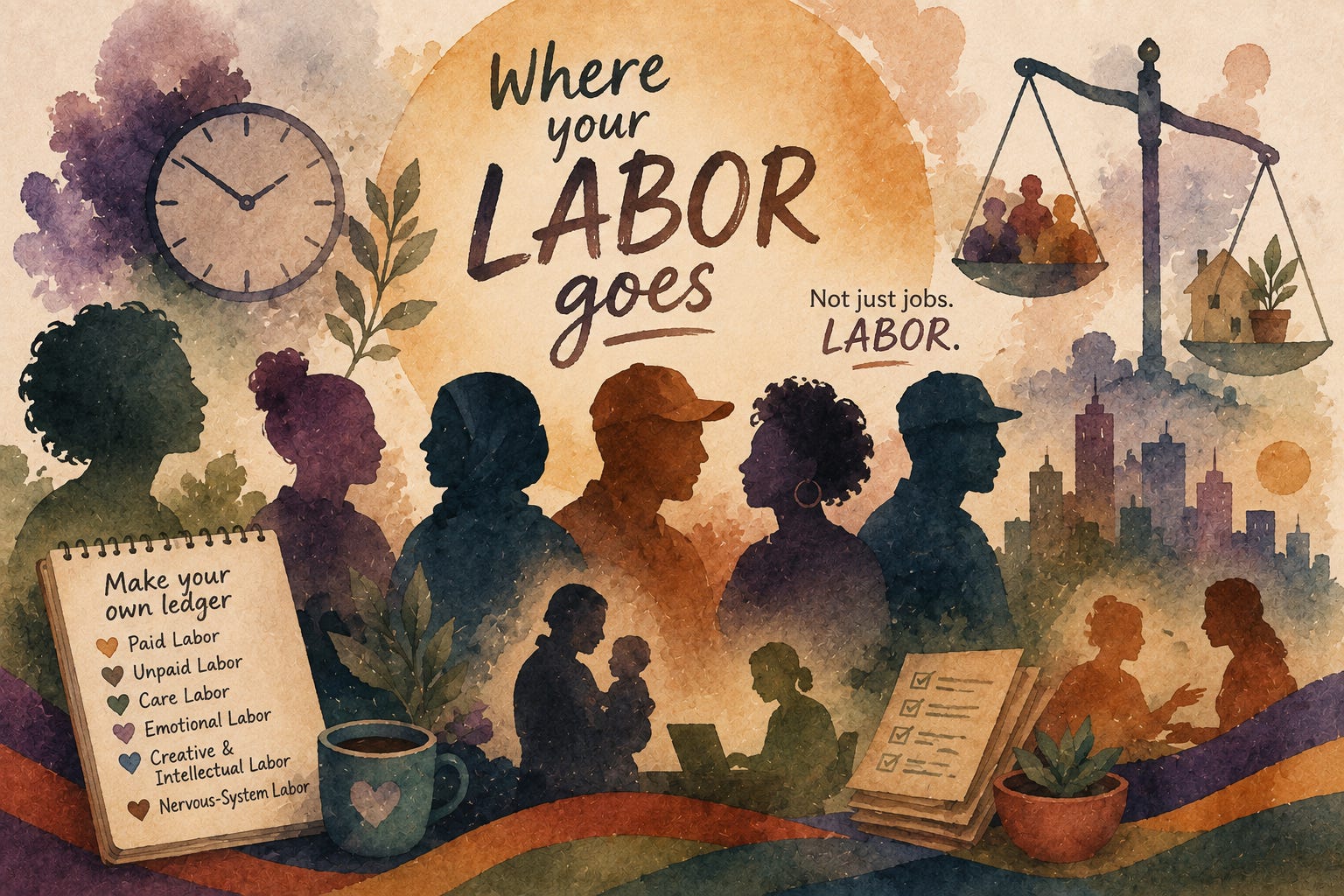
Before we talk about changing our relationship with labor, we probably need to know where the hell all of it is going.
Last year I had a thread go viral because I suggested staggered school start times as one possible way to make schools more accessible for neurodivergent children and families.
And people LOST IT.
One of the responses I kept seeing was some version of:
“Teachers already work 40 hours a week! You want us to work MORE?!”
Except… I had never said that.
I wasn’t suggesting anybody extend their workday. I was talking about staggered schedules.
Shift work.
A thing that exists in approximately 47 million other industries.
Everybody does not have to arrive and leave at the same time for an institution to operate across a longer window.
But that wasn’t actually the most interesting part of the conversation to me.
The interesting part was how people were counting their labor.
Because someone would tell me: I already work from 7:30 to 3:30.
And then, somewhere else in the same conversation, explain that they were waking up at 3:30 or 4:00 in the morning.
Getting themselves ready. Getting their own children situated. Commuting. Arriving early. Preparing their classroom. Staying after students left. Driving home. Answering emails. Grading. Planning for tomorrow.
And then tell me: “I work eight hours.”
And I remember thinking: Baby… no you don’t.
Your employer may compensate you according to an eight-hour workday.
The institution may recognize eight hours. Your contract may name eight hours.
But your body has been participating in the conditions required for those eight hours for much longer than eight hours.
And THAT distinction has stayed with me, and that is what brings me to labor.
Not just jobs.
Labor.
The shit we do all day that requires something from us.
Because when somebody asks, “How much do you work?” most of us immediately start calculating the hours attached to a paycheck.
Forty hours.
Twenty hours.
Full-time.
Part-time.
Self-employed, which means I don’t know because apparently I live at work, and it never stops.
But paid work is only one place our labor goes.
You answered the email.
Made the appointment.
Remembered the birthday.
Checked on the friend.
Drove the kid.
Made dinner.
Figured out what was going to be dinner.
Listened to somebody process the same situation for the fourth time.
Managed the tension in the room.
Did the research.
Made the graphic.
Had the idea.
Fixed the thing nobody else noticed was broken.
Remembered that the cat needs food, somebody needs new shoes, the permission slip is due Thursday, and there is absolutely no toilet paper upstairs. ( I am exhausted typing this)
That is labor too.
Many of us understand this concept when we talk about the invisible labor women perform inside the home. But I want us to widen the lens and recognize the invisible labor capitalism requires from all of us in order to function.
Because extraction is not an accidental feature of the economic system we inherited.
Extraction is foundational to it, and in order to build liberated communities, we need to understand how to rebuild in a different way (parallel systems)
The development of the United States economy cannot be separated from stolen Indigenous land, enslaved African labor
Dispossession, and the conversion of human beings and natural resources into wealth for somebody else is the absolute truth of the creation of the current colonial project we live in and are actively working on dismantling.
When your economic baseline is getting the resource for as little as possible (preferably nothing), then paying the full cost of labor will always feel excessive.

And that logic does not stay inside corporations. It becomes culture. It becomes how institutions measure labor. And eventually, it becomes how we measure ourselves.
We start counting only the hours someone agreed to pay us for. Not the preparation. Not the commute. Not the recovery. Not the emotional regulation required to remain employable. Not the care infrastructure required for us to show up at all.
Not what the body had to do before, during, and after the shift.
The institution gives us a timesheet, and eventually we start using it to explain our own lives back to ourselves.
That is how oppression reproduces itself.
People talk endlessly about wealth “trickling down.”
I’m far more convinced that what actually does trickle down is… The logic of oppression.
Extraction moves from systems → institutions → relationships → bodies.
Eventually we can become so accustomed to undercounting our own labor that when somebody points out the actual cost, we experience the accounting itself as unreasonable.
Which brings me back to that teacher who said, “I work eight hours.”
Maybe… I guuesssss.
But before we can decide whether our labor is aligned, exploited, reciprocal, underpaid, freely given, or simply exhausting, we have to stop letting the institution do all the counting.
So today, we are going to make our own ledger.
Some of us are walking around saying: “I didn’t really do anything today.”
Meanwhile, our bodies are like: B*#ch, WHAT?!
So this week’s Black August practice is not about becoming more productive.
We are going to do something much more useful.
We are going to find out where our labor is actually going.
The Labor We Count and the Labor We Don’t
One of the things capitalism does remarkably well is convince us that labor becomes legitimate when somebody else attaches money to it.
This is part of the basis of supply and demand, and part of how we end up exhausted in liberation work.
If I facilitate a workshop for an organization, that’s work.
If I spend two hours helping someone in my community understand the exact same concept for free, somehow that becomes helping.
If someone is paid to care for children, they’re working.
If a parent spends the entire day caring for children, they may still say they “didn’t work today.”
If somebody gets paid to manage a project, that’s management.
But if you’re the person in your family remembering every appointment, deadline, medication, birthday, grocery need, school event, emotional temperature, and household responsibility? That’s adulthood… You’re just good at keeping things together.
And once you start looking for these contradictions, they are EVERYWHERE.
Your husband cuts the grass, and it can be understood as a chore, responsibility, or even part of “being the man of the house. But let him not be there.
Now you hire somebody to cut the exact same grass, and suddenly we understand it as a job.
You make dinner every night, and it can be dismissed as a wifely duty.
But when a stranger prepares your dinner in a restaurant, we understand immediately that their time, skill, preparation, and service constitute labor worthy of compensation.
A daycare worker caring for children is performing labor.
A parent caring for children all day is “just parenting.”
A consultant can charge hundreds of dollars an hour for strategy.
But the friend everybody calls to think through the business, the relationship, the crisis, the next move? They’re “just really good at giving advice.”
A child can spend seven hours at school, commute home, and then spend another two or three hours completing homework, and we call that responsibility.
But put that same structure inside paid employment and suddenly we have language for work performed outside designated hours.
And even THEN it gets complicated.
A project manager can work 60 hours in the office and another 20 outside of it, and whether those additional hours are even recognized as compensable labor can depend on how the worker is classified and what labor protections apply.
Same human energy.
Same finite hours.
Same body doing the doing.
Different economic designation.
And THAT is what I want us to notice.
Because the difference is not whether labor occurred.
The difference is who had the authority to name it labor.
Who performs that invisible labor has never been random.
When we examine supremacy culture through race, gender, class, disability, citizenship, socioeconomic status, and access to capital, patterns emerge around whose labor gets compensated, whose gets discounted, and whose is simply expected.
Our economic systems have long depended on care work, domestic work, reproductive labor, emotional labor, and community labor being underpaid, unpaid, or treated as naturally available.
And eventually that logic gets inside us.
We don’t just allow institutions to undervalue certain kinds of labor.
We begin undervaluing them ourselves.
The market recognizes the restaurant worker’s labor, so we recognize it.
The market doesn’t issue a paycheck for making dinner for your family, so we call it something you’re supposed to do.
But your body does not give a damn what category capitalism put it in.
Your body still expended energy.
Your attention still went somewhere.
Your time still passed.
Your nervous system still held the demand.
And you may still require recovery afterward.
The body keeps a different timesheet.
Breaking away from the accounting system we inherited begins with learning to read that one too.
So when we talk about the economics of the nervous system, we have to count more than wages.
We have to ask:
What does my life require from my body in order to keep functioning?
🔒 Now We Make Our Own Ledger
If you’ve gotten this far and started mentally adding up all the labor you weren’t counting...
Good.
Not because I want you angry at every demand on your time.
Not because every unpaid act is exploitation.
And definitely not because we’re about to turn every relationship into a transaction.
We’re doing this because you cannot discern extraction from reciprocity when you can’t see the labor.
Below the paywall, we’re going to map six places your labor actually goes:
Paid labor.
Unpaid labor.
Care labor.
Emotional labor.
Creative and intellectual labor.
Nervous-system labor.
And then we’re going one step further.
We’re going to look at cost.
What preparation did this labor require?
What did your body have to do to perform it?
How much recovery does it require afterward?
Who benefits from it?
What comes back to you?
And does this labor feel extracted, reciprocal, aligned, or simply necessary right now?
Because the goal isn’t to create another list of everything wrong with your life.
The goal is to develop enough awareness to make choices.
And This Is Labor Too
These Liberation Practices don’t appear out of nowhere.
The research, writing, synthesis, frameworks, somatic practices, community spaces, Academy resources, and the time it takes to turn political education into something we can actually practice as praxis, are labor.
I want this education accessible… I also refuse to build accessibility through my own extraction.
That is part of what my Road to $100K is about.
I am building an economic model where the people who have capacity help sustain the work, collaborators can be compensated, scholarships remain available, and the people who do not have financial capacity are not required to prove their hardship to belong here.
Paid subscriptions are $10/month or $100/year.
Equity Partners are $150/year, helping create access for others while sustaining the larger Liberation Education ecosystem.
And if cost is the barrier, scholarships are available at Scholarships@DesireeBStephens.com.
No proof required.
No trauma story owed.
Just ask.
Because if we’re going to spend August examining extraction, labor, reciprocity, and how resources move, then I’m going to practice that here too.
Labor should be acknowledged.
Resources should circulate.
Access should be protected.
Reciprocity should be practiced.
Now...
let’s make this timesheet.
Continue reading with a paid subscription.
