
Love and Liberation
Transmuting Supremacy Culture Within

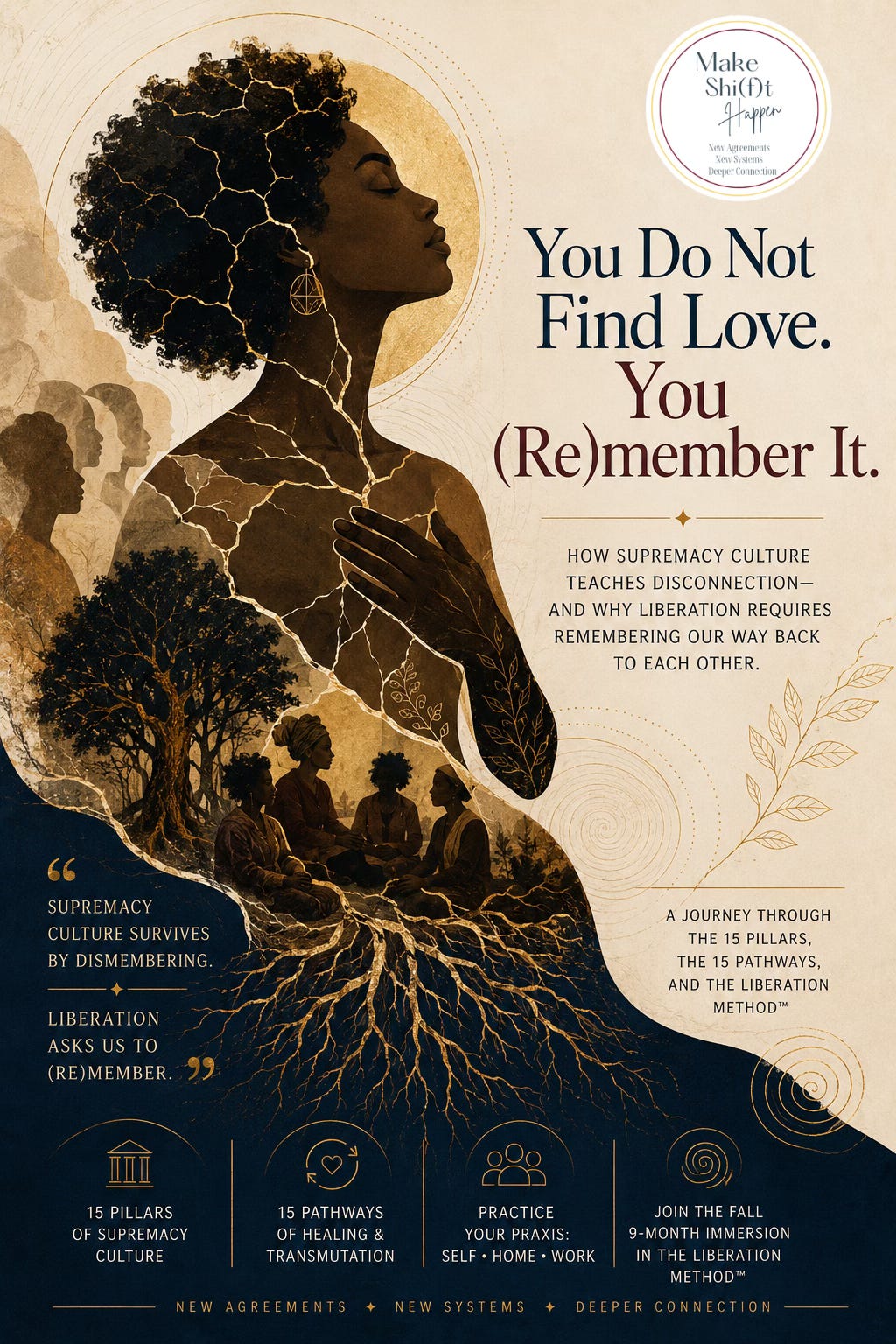
Good morning and happy day… Let me share some thoughts with you.
There is something deeply disorienting about trying to love inside a culture that has trained you to fear.
Fear abandonment.
Fear softness.
Fear difference.
Fear vulnerability.
Fear being “too much.”
Fear being unseen.
Fear being fully known.
Supremacy culture thrives on fragmentation.
Either/or thinking.
Us versus them.
Deserving versus undeserving.
Good versus bad.
Safe versus unsafe.
Human versus less human.
And when you are raised inside those binaries long enough, you stop relating to love as something innate.
You begin relating to love as something conditional.
Transactional.
Scarce.
Something to earn.
Something to chase.
Something to prove yourself worthy of receiving.
But maybe love was never something you were supposed to find.
Maybe love is something you remember.
That word itself feels important to me:
(re)member.
To member again.
To reconnect with the whole.
To return to what was fragmented.
Because supremacy culture survives by dismembering.
It disconnects people from body.
From land.
From ancestry.
From community.
From grief.
From softness.
From interdependence.
From each other.
From themselves.
And then it sells the cure back to us in the form of consumption, performance, hierarchy, domination, and extraction.
But liberation asks different questions.
Not:
“How do I become lovable?”
But:
“What interrupted my ability to remember that I already belonged?”
Not:
“How do I find love?”
But:
“What barriers have I built against it in order to survive?”
That is why the Rumi quote has always felt less romantic to me and more like a liberation practice:
“Your task is not to seek for love, but merely to seek and find all the barriers within yourself that you have built against it.”
Because those barriers are not accidental.
Many of them were taught.
Inherited.
Rewarded.
Conditioned.
Survival responses formed inside oppressive systems.
Some barriers look like defensiveness.
Some look like perfectionism.
Some look like hyper-independence.
Some look like people pleasing.
Some look like emotional avoidance.
Some look like control.
Some look like fear of conflict.
Some look like needing certainty before vulnerability.
And if we are honest, many of these mirror the very pillars of supremacy culture itself.
The body learns the culture it survives inside.
So liberation work is not simply intellectual.
It is relational.
Somatic.
Spiritual.
Communal.
It is the practice of remembering what the body knew before domination taught it otherwise.
Before love became possession.
Before intimacy became performance.
Before vulnerability became danger.
Before community became competition.
Love, from a liberation lens, is not passive.
It is a refusal to participate in disconnection.
It is choosing presence in a world organized around fragmentation.
It is the courage to remain human in systems that reward numbness.
And perhaps that is why liberation cannot happen through ideology alone.
Because you cannot think your way into wholeness while remaining disconnected from your body, your relationships, your grief, your tenderness, and your capacity to receive and give care.
Liberation requires remembering.
Remembering that softness is not weakness.
Remembering that interdependence is not failure.
Remembering that rest is not laziness.
Remembering that vulnerability is not incompetence.
Remembering that care is not transactional.
Remembering that love is not scarcity.
And maybe most importantly:
Remembering that domination is learned.
Which means it can also be unlearned.
Take a breath here.
Notice what comes up in your body when you consider the possibility that love is not something outside of you waiting to be earned.
Notice what happens when you imagine that love may actually be your original state before fear taught you otherwise.
Not perfected love.
Not performance love.
Not saviorism.
Not martyrdom.
Just presence.
Connection.
Care.
Truth.
Belonging.
The work, then, is not becoming worthy of love.
The work is grieving everything that taught you that you weren’t.
And slowly, intentionally, practicing your way back into remembering.
What if the barriers to love are not simply personal wounds…
but systemic conditioning?What if the body learned supremacy culture long before the mind ever had language for it?
And what if liberation is not only about naming oppression…
but developing pathways capable of transmuting it?Below the paywall, I want to walk you deeper into the architecture of these systems, how they operate relationally and somatically, and how The Liberation Method™ emerged as a response to the fragmentation supremacy culture creates inside our bodies, homes, communities, and movements.
