

If you’ve found this article through a search for the 15 Pillars of Supremacy Culture, welcome.
I originally published this page after completing my Unpacking the 15 Pillars of Supremacy Culture series as a quick-reference summary of the patterns we’d explored together.
Years later, thousands of people have encountered this work through my writing, teaching, and resources, and this page continues to be one of the ways people find it.
So rather than replace it, I’ve updated it to reflect an important development in my work:
Recognition is necessary. But recognition is not the destination.
Learning to see supremacy culture helps us notice patterns that can become so normalized we mistake them for personality, professionalism, good leadership, productivity, family values, or simply the way things are.
But eventually we have to ask another question:
Once we recognize the pattern, what do we practice instead?
That question now sits at the heart of my work through The Liberation Method™.
What Is Supremacy Culture?
Supremacy culture describes cultural patterns that normalize hierarchy, domination, extraction, control, and particular ideas about whose knowledge, comfort, productivity, authority, and ways of being are valued.
These patterns don’t exist only “out there” in institutions.
We can learn and reproduce them through Self, Home & Relationships, and Work & Community.
That does not mean oppression can be reduced to individual behavior. Racism, colonialism, capitalism, ableism, patriarchy, and other systems of oppression are material, historical, political, and institutional realities.
Recognizing cultural patterns helps us examine how those systems are normalized, embodied, reproduced, and practiced.
A Note on Lineage
The language of white supremacy culture did not originate with me.
This work is indebted to a much longer lineage of organizers, educators, and movement workers, including Tema Okun and Kenneth Jones, whose 1999 White Supremacy Culture article became an important resource for people and organizations examining the cultural characteristics that uphold white supremacy.
My contribution has been years of teaching, interpreting, applying, and expanding this work through a relational and somatic lens… and developing the larger liberation architecture that grew from asking what comes after recognition.
Lineage matters.
So does what we build with what we’ve inherited.
Unpacking the 15 Pillars of Supremacy Culture: A Summary
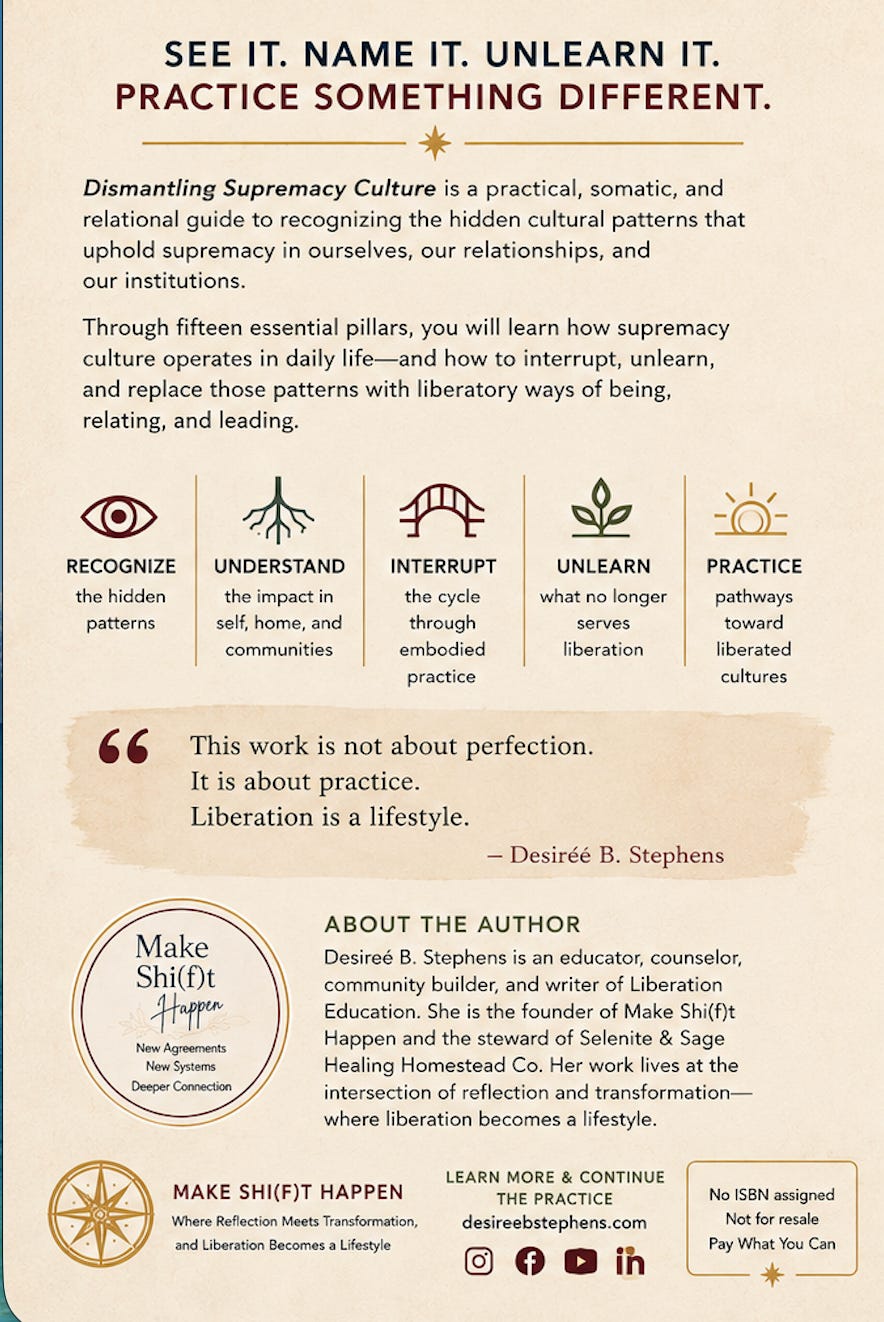
As we have now concluded the “Unpacking the 15 Pillars of Supremacy Culture” I would like to provide you with a brief summary of what it is, and what they are and invite you to go deeper into your anti-oppression journey. It is imperative to see how each and every person, animal, and land is impacted by these pillars in order to begin the journey to liberation through decolonization and whole self-healing.
Supremacy culture, a term that encapsulates the systemic and pervasive nature of dominance in societal structures, is built upon various pillars that sustain and perpetuate inequality and oppression. These pillars, while distinct, interact in complex ways to maintain the status quo of power dynamics. In this blog, we'll summarize the 15 pillars of supremacy culture, offering a brief definition of each based on our exploration so far.
1. Perfectionism
Perfectionism in supremacy culture is the relentless pursuit of flawless performance and the intolerance of mistakes, not only setting unattainable standards but also stifling creativity and innovation by fearing failure.
2. Sense of Urgency
This pillar involves prioritizing quick results and immediate responses without acknowledging the benefits of thoughtful deliberation, often at the expense of deeper, more meaningful progress and inclusivity.
3. Defensiveness
Defensiveness is the protective stance taken to preserve power dynamics and avoid accountability. It manifests as resistance to critique, feedback, or challenges, often shutting down opportunities for growth and change.
4. Quantity Over Quality
A focus on the amount produced rather than the impact or depth of work. This pillar values metrics and outputs over transformation and meaningful engagement, often leading to burnout and superficial achievements.
5. Worship of the Written Word
This pillar elevates written communication and formal documentation as the most valid and valued form of knowledge, often marginalizing oral histories, traditions, and other forms of knowledge transmission.
6. Only One Right Way
The belief that there is a single correct approach or solution to any given problem, ignoring the diversity of perspectives and approaches that could provide more nuanced and inclusive outcomes.
7. Paternalism
Paternalism involves decision-making by those in power without input from those affected by the decisions, assuming a "father-knows-best" attitude that undermines agency and participation.
8. Either/Or Thinking
Reducing complex issues to binary choices, this pillar oversimplifies the richness of possibilities and perspectives, creating false dichotomies and fueling division.
9. Power Hoarding
The tendency to keep power concentrated in the hands of a few, resisting efforts to distribute power more equitably and to foster shared leadership and decision-making.
10. Fear of Open Conflict
This pillar involves avoiding conflict and uncomfortable conversations in favor of maintaining a façade of harmony, often at the cost of addressing and resolving underlying issues.
11. Individualism
The emphasis on personal success and independence often neglects the importance of community, collective well-being, and interdependence.
12. Progress is Bigger, More
Equating growth and success with expansion and accumulation, this pillar overlooks the value of sustainability, balance, and the quality of outcomes.
13. Objectivity
The myth of unbiased perspectives, which denies the role of subjective experiences in shaping understanding, often dismisses emotional and experiential knowledge as invalid.
14. Right to Comfort
Prioritizing personal comfort and avoiding discomfort, especially in conversations about race, equity, and justice, thereby hindering progress and deep understanding.
15. I’m the Only One
Believing that one is the sole person capable of performing tasks or having the necessary knowledge, undermining collaborative efforts and collective wisdom.
Conclusion
Understanding the 15 pillars of supremacy culture is crucial for anyone committed to dismantling oppressive systems and fostering a more equitable society. By recognizing and challenging these pillars in our daily lives, workplaces, and communities, we can contribute to the creation of spaces that value diversity, equity, and inclusion. As we continue to explore and deconstruct these pillars, let's commit to the ongoing work of decolonization, healing, and building inclusive communities. By engaging with these concepts, we can all play a part in reimagining and reshaping our world into one that uplifts and values every individual.
Recognition Is Where We Begin
When I originally taught and wrote about these Pillars publicly, much of the work centered on helping people recognize the architecture.
And recognition still matters.
You cannot intentionally interrupt something you cannot see.
But after years of teaching this work, another question became increasingly unavoidable:
What do we practice instead?
Because knowing that perfectionism is operating doesn’t automatically teach us another way to learn.
Recognizing power hoarding doesn’t automatically create shared power.
Naming fear of conflict doesn’t give a community the capacity to practice conflict differently.
And intellectually understanding supremacy culture doesn’t mean our bodies, relationships, organizations, or communities suddenly know another way.
That is where the work has continued to grow.
From the 15 Pillars to the 15 Pathways of Liberation©
The 15 Pathways of Liberation© emerged from that next question.
For example:
Perfectionism → Iterative Learning
Power Hoarding → Shared Stewardship
Fear of Open Conflict → Generative Conflict
And there are twelve more.
The goal isn’t to replace one rigid list with another.
It’s to move from:
recognition → practice → embodiment → culture.
Because dismantling was never the destination.
Liberation is something we practice.
Want to Go Deeper?
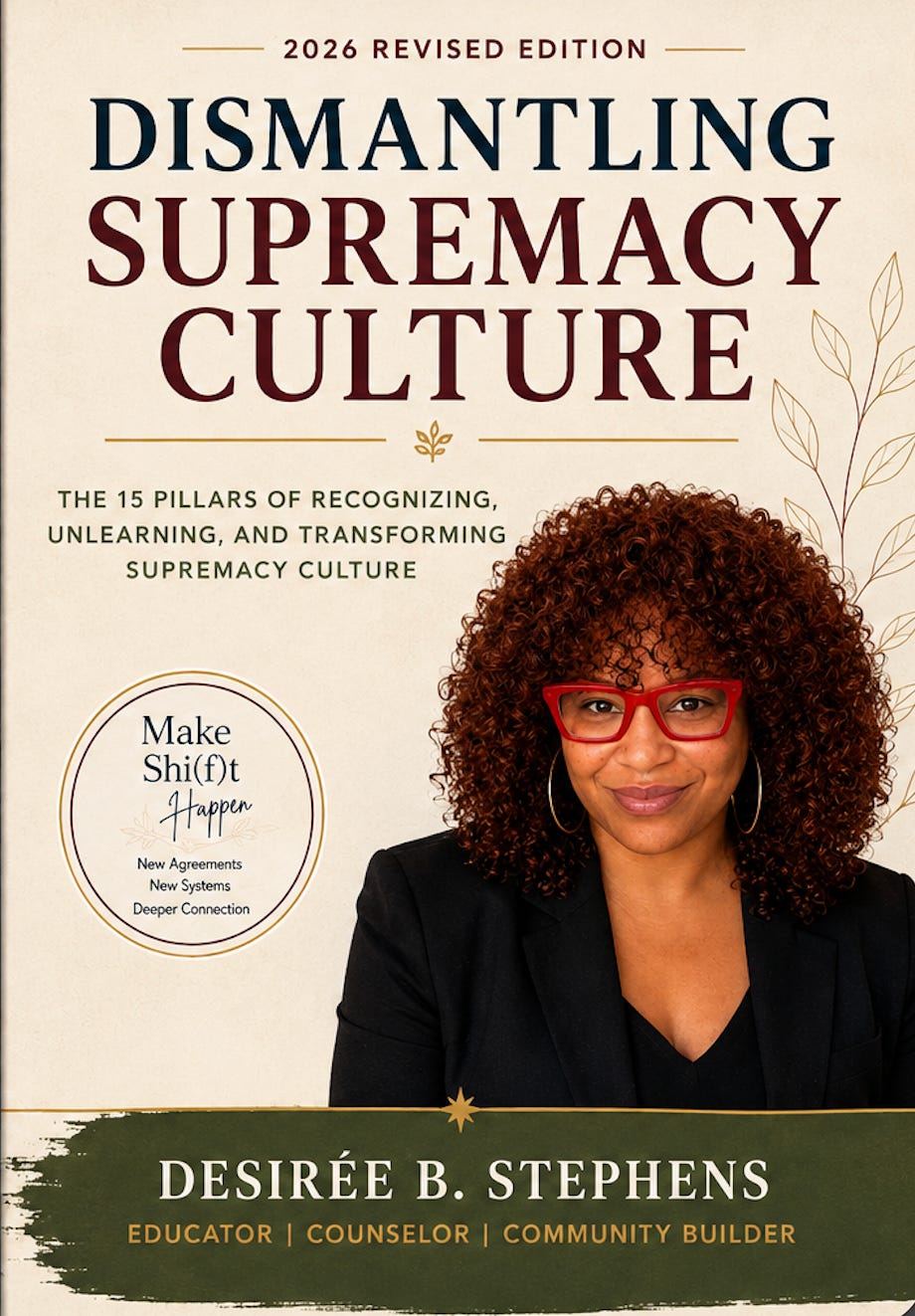
I’ve completely revised and expanded Dismantling Supremacy Culture: Understanding the 15 Pillars—and Practicing Another Way for 2026.
The revised edition includes deeper context and lineage, somatic practice, reflection questions, Practice Your Praxis™, a glossary, a printable 15 Pillars Recognition Map, and an introduction to where this work goes next.
→ GET THE 2026 REVISED EDITION
It is Pay What You Can, including $0.
And if you’re ready to move beyond reading:
→ JOIN THE LIBERATION EDUCATION ACADEMY
Learn and practice through the larger body of Liberation Education and The Liberation Method™.
→ EXPLORE THE LIBERATION JOURNEY
Go deeper through a nine-month facilitated pathway of learning, practice, embodiment, and community.
In Solidarity and Liberation,
Desireé B. Stephens
Somatic Educator | Counselor | Community Builder
Founder, Make Shi(f)t Happen
Writer of Liberation Education
Where Reflection Meets Transformation, and Liberation Becomes a Lifestyle.