Where We Become Water
Love as a Liberation Practice

My work reflects the cycles of my life because liberation is not an action plan.
It is not a checklist.
It is not a perfectly performed ideology.
Liberation is a reorienting of your entire existence.
And lately, liberation has been teaching me through love… Take a breath 🌬️
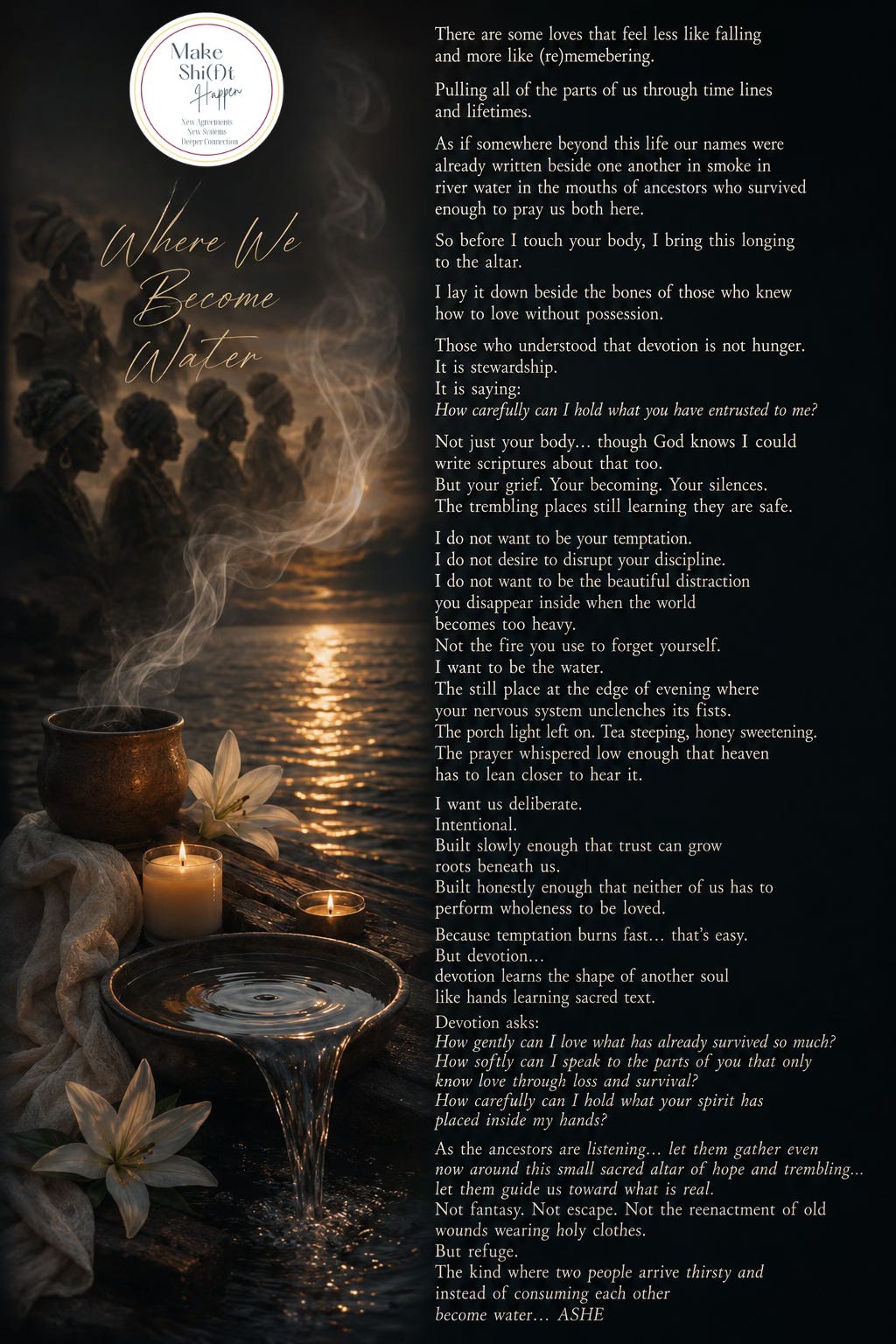
This morning I wrote this… ( I will share it after this reflection)
I haven’t written poetry in over a decade, and I am sitting with what that means and the wound that caused me to close that door that was once such a vital pathway of my processing. I am sitting with what that meant in my life, relationships, marriage, parenting, and more. If I closed off that part of my expression, what else had I possibly walled off, and how did that impact the lives around me with that closure?
I am thankful for the relationships that have come into this iteration of my life to open up that doorway again and invite me to walk that path yet again, gently. Relationships that reminded me expression was never the wound.
Suppression was.
One of course being The Gospel of LadySpeech, who came and healed the wounds of friendship loss. The other, this man whom we shall call Love Jones, is actively softening wounds around intimate partnership, wifehood, desire, and being witnessed without performance.
I am grateful that life keeps evolving me toward deeper and deeper liberation.
Ashe.
There is a kind of love that supremacy culture does not prepare us for.
Not because it is rare…
but because domination requires disconnection to survive.
We are taught how to pursue.
How to possess.
How to consume.
How to perform desire.
How to attach ourselves to longing and call it devotion.
But we are rarely taught how to love without abandonment of self.
We are rarely taught how to approach another person without projection, extraction, urgency, performance, or ownership.
We are rarely taught how to love slowly enough for safety to emerge.
And perhaps that is why so many people confuse intensity with intimacy. (myself included)
Because wounded systems often mistake activation for aliveness.
Supremacy Culture Teaches Consumption, Not Stewardship
“I do not want to be the beautiful distraction you disappear inside when the world becomes too heavy.”
This line within the poem matters because supremacy culture teaches us to use people, and not in the ways of reciprocal care where we each are benifical to each other as an ecosystem, but rather in the ways of extraction, Supremacy culture teaches us to use others…
As escape.
As proof.
As validation.
As regulation.
As status.
As fantasy.
As emotional labor.
As placeholders for wounds we have not tended.
But liberation asks:
Can you love someone without consuming them?
Can you approach intimacy without possession?
Can you remain connected to yourself while loving another person deeply?
Can you honor another person’s becoming without trying to control its pace?
This is why devotion feels revolutionary.
Because devotion requires responsibility.
Not ownership.
Not martyrdom.
Not codependence.
Stewardship.
And stewardship asks:
How carefully can I hold what has been entrusted to me?
In a previous article (also inspired by Love Jones) I explored the many ways we can love one another and how love does not need to be hierarchical in order to be meaningful.
Love Is Not Separate From Liberation
People often think liberation work only lives inside protest, policy, education, or organizing.
But liberation also lives in how we love.
How we repair.
How we listen.
How we pace ourselves.
How we approach conflict.
How we hold power.
How we navigate tenderness.
How we create safety.
How we remain human with one another.
Because if supremacy culture fractures connection…
then love becomes one of the places we practice (re)storing it.
Not romanticized love.
Not performative love.
Not saviorism disguised as intimacy.
But grounded love.
The kind that allows two nervous systems to soften without disappearing.
The kind that creates enough spaciousness for truth to exist.
The kind that does not require performance in order to receive care.
The Wounded Self Cannot Sustain Liberation
The wounded self often approaches love through fear.
Fear of abandonment.
Fear of inadequacy.
Fear of vulnerability.
Fear of not being chosen.
Fear of loss.
And fear makes us rush.
Rush intimacy.
Rush attachment.
Rush certainty.
Rush projection.
Rush belonging.
But liberation teaches pacing.
It teaches nervous system awareness. (I can not tell you how many times I had to remind myself to exhale whilst wtiting this)
It teaches discernment.
It teaches us that slowness is not rejection.
And perhaps one of the deepest forms of healing is learning that love does not have to arrive through chaos in order to be real.
Sometimes love sounds like:
“Take your time.”
Sometimes love looks like:
“I do not want to consume you.”
Sometimes love says:
“I will not abandon myself in order to keep you.”
Sometimes love becomes:
water…
Invitation
Below the paywall, I want to explore how supremacy culture shapes intimacy itself through the 15 Pillars, why nervous system regulation changes the way we approach love and conflict, and how devotion becomes a liberation practice capable of sustaining both relationships and movements. One of my favorite quotes on love fully encompasses this journey: